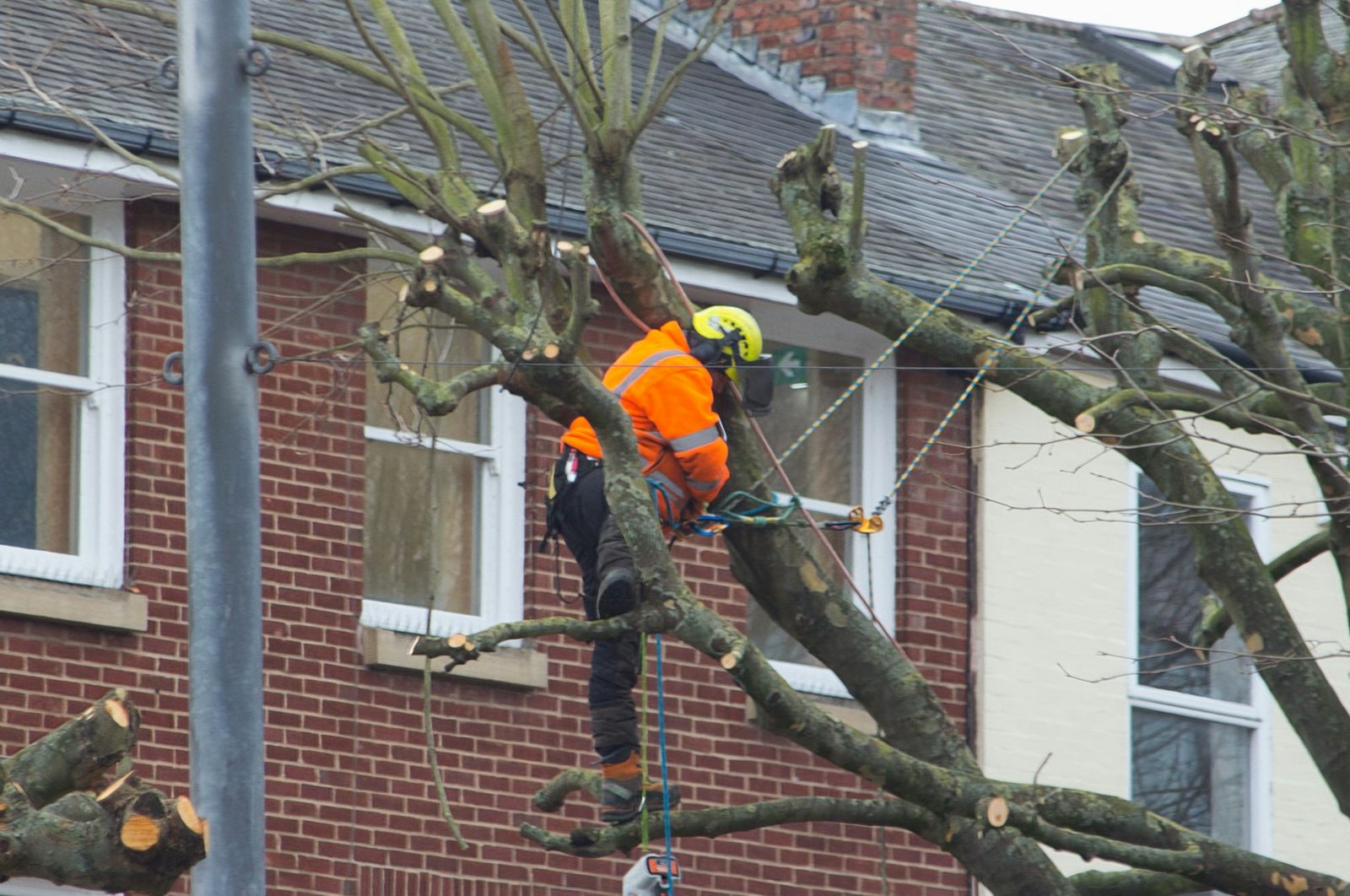
After ice, stay out from under the trees until the wires around them are sorted out. Then deal first with broken limbs hanging over people, roofs or the street. Whether the rest of the tree can stay is a question for a clear day, when you can see the whole crown. This site is not for emergencies: with a limb on a wire or the roof, or anyone hurt, call 911 or the line company.
What October 2020 showed
The National Weather Service event page has the storm starting on the morning of October 26, 2020 and running into the evening of October 28. Its spotter and public reports read like a map of the metro:
- Northwest of Warr Acres, 9:06 on the first morning: two silver maple branches down with only a glaze of up to 1/8 inch of ice.
- SW 104th and Penn: 0.31 inch measured. Will Rogers Airport: 0.4 inch on a fence.
- West side of Lake Overholser: from 0.75 to nearly 1 inch, with "Large trees down at Lake Overholser".
- Nichols Hills: "Large pine tree uprooted".
- 16th and N Hudson: "Large uprooted tree blocking street".
- Eastlake Estates in Moore, off Western and 134th: "Major trees downed".
Those are single reports, some of them photos sent by the public, so they are not a measured grid. They do show how uneven it was across town, and that less than half an inch was enough to bring limbs down: NWS staff near Edmond measured 0.3 inch on tree limbs with several limbs down.
Why that storm hit so hard
The trees had not dropped their leaves. The Oklahoma Mesonet wrote that trees "still burdened with a full head of leaves so early in the season, were easy prey", and it counted nearly 400,000 homes and businesses without power. An OG&E spokesman told reporters at the time: "You still have leaves on branches that create a considerable amount of weight." Eleven days after the storm began, the state emergency update still listed 42,433 outages for Oklahoma City, in a state of emergency that covered Oklahoma County.
Even the Survivor Tree at the Oklahoma City National Memorial was hit. The memorial said at the time, "We lost a branch but have propped up others to save them." A lost limb is not always the end of a tree, so have someone look before you decide.
Ice in winter does it too. For December 9 to 11, 2007, the NWS page carries an Oklahoma City emergency manager's report of widespread tree damage over much of the area, and more than 641,000 electric customers out statewide at the peak.
Trees the local guides flag
This comes from the city's own tree guide, Putting Down Roots, unless noted. It helps when you are deciding whether a damaged tree is worth saving.
| Tree | What the guide says |
|---|---|
| Callery pear, including Bradford | Weak, densely branched limbs at acute angles can split large branches or the whole tree "after ten or more years of growth". Bradford was the most commonly planted. |
| Silverleaf (silver) maple | Grows fast and is "notorious for receiving wind damage". |
| Sweetgum | Wood of moderate strength that "may break under the strain of ice". |
| Cottonwood | Rapid growth gives "soft, weak wood". |
| Live oak | Flagged on the city's 2016 street tree list as susceptible to snow and ice loads. |
| Anything topped | ISA says the regrowth is weakly attached and likely to snap, above all in wind or ice. |
| Big trees pruned hard under wires | The guide says that kind of pruning weakens the tree and creates hazards from wind and ice. |
If you are replacing a tree, the same guide says ginkgo's wood resists breakage from ice and harsh winds, and that Osage orange is extremely strong and resistant to wind and ice. It also recommends trees under 30 feet for home landscapes.
What to check once the ice is gone
Look from the ground, with the wires in mind. A big tree near the house or the sidewalk deserves an arborist's check, ISA says, even when it looks untouched: split wood, limbs caught in the crown, and soil that has lifted around the roots are what they look for. A hung limb, or a tree leaning on a roof, can still shift well after the weather clears.
The city's guide says to "ALWAYS consult an expert before pruning trees with storm damage", and that some trees "may require removal instead of selective pruning". For small breaks, OSU's pruning fact sheet says to prune storm damage as soon as you can, to head off insect and disease problems, while the guide draws the line at what you can do safely from the ground with a hand tool. Anything higher belongs to someone equipped for it.
Oklahoma Forestry Services keeps a page on saving storm damaged trees, and it sets the same order: power restored and safety issues resolved first, then the trees.
Who takes the limbs
After the 2020 storm the city ran debris passes. The first began November 16, 2020, and in February 2021 contractors were still cutting and hauling limbs two inches or thicker hanging over public rights-of-way. That was the plan for that storm, not a standing promise. The curb pickup page has today's rules, and the tree down page covers insurance.
Phone line opening soon
Allow us to connect you to a local pro.
Sources
- National Weather Service Norman, October 26 to 29, 2020 ice storm event page
- Oklahoma Mesonet, Historic Storm Haunts October (November 2, 2020)
- Fox News report on the ice storm and the Survivor Tree (October 28, 2020)
- Oklahoma Department of Emergency Management, Situation Update 11 (November 6, 2020)
- National Weather Service Norman, December 2007 ice storm event page
- City of Oklahoma City Planning Department, Putting Down Roots, second edition, about 2010 (PDF on the state forestry site)
- City of Oklahoma City, Trees and Plants for Oklahoma City (PDF, dated August 2, 2016)
- International Society of Arboriculture, Why Topping Hurts Trees (PDF, 2021)
- International Society of Arboriculture, Storm-Related Tree Damage (PDF, 2021)
- Oklahoma State University, Pruning Ornamental Trees, Shrubs, and Vines, HLA-6409 (PDF, an older copy)
- Oklahoma Forestry Services, Saving Storm Damaged Trees
- City of Oklahoma City, Storm debris pick-up nearing completion (February 9, 2021)
Read on 2026-11-05. External pages can change.