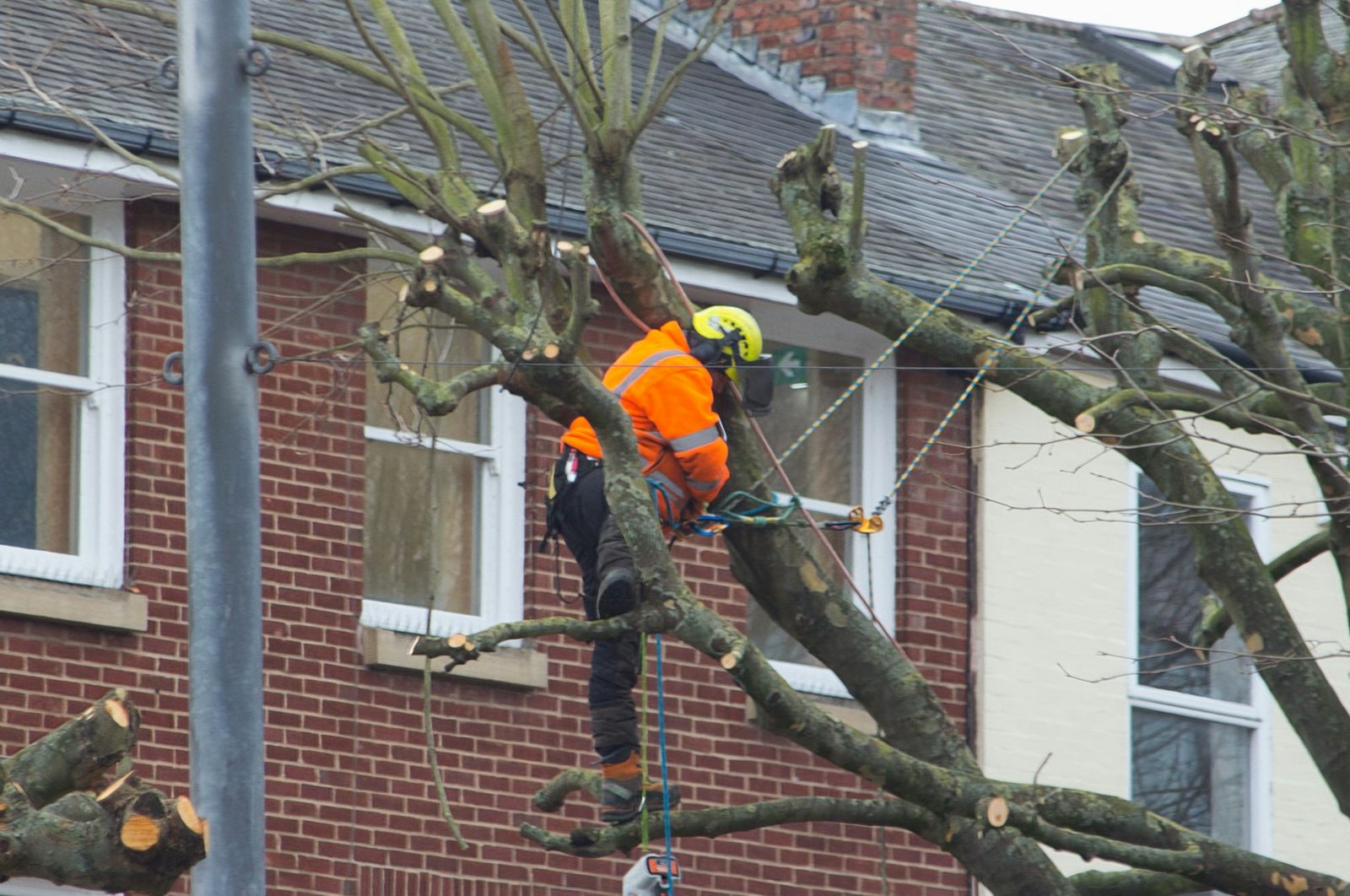
First work out which wire you are looking at. The wire from the pole to your house is yours to keep clear. The wires running from pole to pole are OG&E's, and OG&E says only its approved line clearance contractors may work near them. If anything is touching a wire or lying on the ground, stop reading and call: this site is not for emergencies.
Two kinds of wire
| Pole to your house (service drop) | Pole to pole | |
|---|---|---|
| Who keeps trees clear | OG&E says it "is a property owner's responsibility". | OG&E. It says it has certified line-clearance arborists pruning and removing on a schedule, across an estimated 2.3 million trees near overhead lines. |
| Who may do the work | OG&E recommends a professional tree service, which "does not need line clearance certification" for this wire. | "OG&E only allows approved Line Clearance contractors to work near their power lines". |
| Doing it yourself | OG&E strongly encourages calling Customer Service for a temporary service disconnect first, to prevent electrocution. | No. OG&E says pruning around power lines should only be done by trained professionals. |
OG&E's FAQ warns that many independent trimmers claim to be line-clearance certified, and that the certification does not transfer between companies unless the company itself is qualified. That is OG&E's warning. We have not checked any company.
If your job is within 10 feet
OG&E says any arborist working on a tree within 10 feet of power lines is technically working "on the electric system" and must have permission from the system operator. Its advice is direct: "If you have a dead tree, or are planning to have work done on a tree closer than 10 feet to the power lines, please contact OG&E for a safety inspection." It adds that in some cases it may need to make the tree safe for removal itself.
In practice that means a company you hire may not be able to start until OG&E has looked at it, so ask early who makes that contact. The residential customer line is 405-272-9741 on weekdays, and the vegetation page has a request form.
What Oklahoma law says
This is the statute as published on the state courts network. It is not legal advice.
- Title 63, Section 981 bars any work where a person, or any part of a tool or material through lateral, vertical or swinging motion, could end up within six feet of any overhead high voltage line.
- Section 982 bars storing, moving or operating tools and equipment within six feet of one.
- Section 985 defines high voltage as more than 750 volts.
- Section 984 makes a violation a misdemeanor, and a person whose violation causes contact can be liable to the line's owner for the damage.
The statute says six feet. OG&E's FAQ says state and federal safety rules require training and certification within 10 feet of a high-voltage line, and its safety guide tells people handling ladders or pole saws to stay 10 to 20 feet away. We did not read those federal rules. Plan around the larger number.
A limb on a line
Leave it. ISA says to never remove branches or any tree part from or near power lines, because they could still be conducting electricity, and to call your electricity provider when you see tree parts touching them. OG&E's emergency line is 405-272-9595 in OKC. If you are on Oklahoma Electric Cooperative, call (405) 321-2024. The rest of this page is OG&E's policy. We found no tree rules on the OEC page we read, so ask them, though the state law above applies either way.
After a storm, the wood is yours
When a storm puts trees across lines, OG&E says it cuts what it must to get the power back. Disposal of that wood "is the property owner's responsibility", and its vegetation page says crews will take debris from the yard to the curb. Routine trimming is different. There it says it will dispose of the debris. Its FAQ says it chips and hauls small limbs, while wood over 4 inches thick may be cut and stacked on site for your use. The curb pickup page covers what the city will take.
If the wire ripped off the house
In 2020 OG&E said many customers had damage to the electrical equipment serving their homes. Its after-an-outage page splits the repair: the wire from the pole to your house and the meter are OG&E's, and the cable down the side of your house and the box holding the meter are yours, which means calling an electrician, not a tree company.
OG&E's own trimming
OG&E says it is trimming trees in Oklahoma City throughout 2026. If you object, its FAQ answers plainly: "permission to prune trees is not required", because utility easements are often conveyed in the deed and service comes with an agreement to allow access. Check your deed or plat if you want to see what yours says.
What to plant in place of it
The city's 2016 plant list says medium to large trees should never be planted under overhead utility lines, and it has a separate list of small trees for within 10 feet of one, including redbud, smaller crapemyrtles and desert willow. Street trees get 10 feet from overhead lines and power poles, with 15 recommended. The city's guide gives the reason: large trees under lines end up harshly pruned, which leaves them open to wind and ice damage.
Phone line opening soon
Allow us to connect you to a local pro.
Sources
- OG&E, Frequently Asked Questions on tree work
- OG&E, Vegetation Management
- OG&E, Contact Us
- Oklahoma Statutes, Title 63, Section 981 (OSCN)
- Oklahoma Statutes, Title 63, Section 982 (OSCN)
- Oklahoma Statutes, Title 63, Section 985 (OSCN)
- Oklahoma Statutes, Title 63, Section 984 (OSCN)
- OG&E, Keeping You and Your Family Safe (PDF)
- International Society of Arboriculture, Recognizing Tree Risk (PDF, 2021)
- OG&E, Safety
- Oklahoma Electric Cooperative, Outage Center
- OG&E, After an Outage
- Fox News report on the ice storm and the Survivor Tree (October 28, 2020)
- City of Oklahoma City, Trees and Plants for Oklahoma City (PDF, dated August 2, 2016)
- City of Oklahoma City Planning Department, Putting Down Roots, second edition, about 2010 (PDF on the state forestry site)
Read on 2026-11-05. External pages can change.