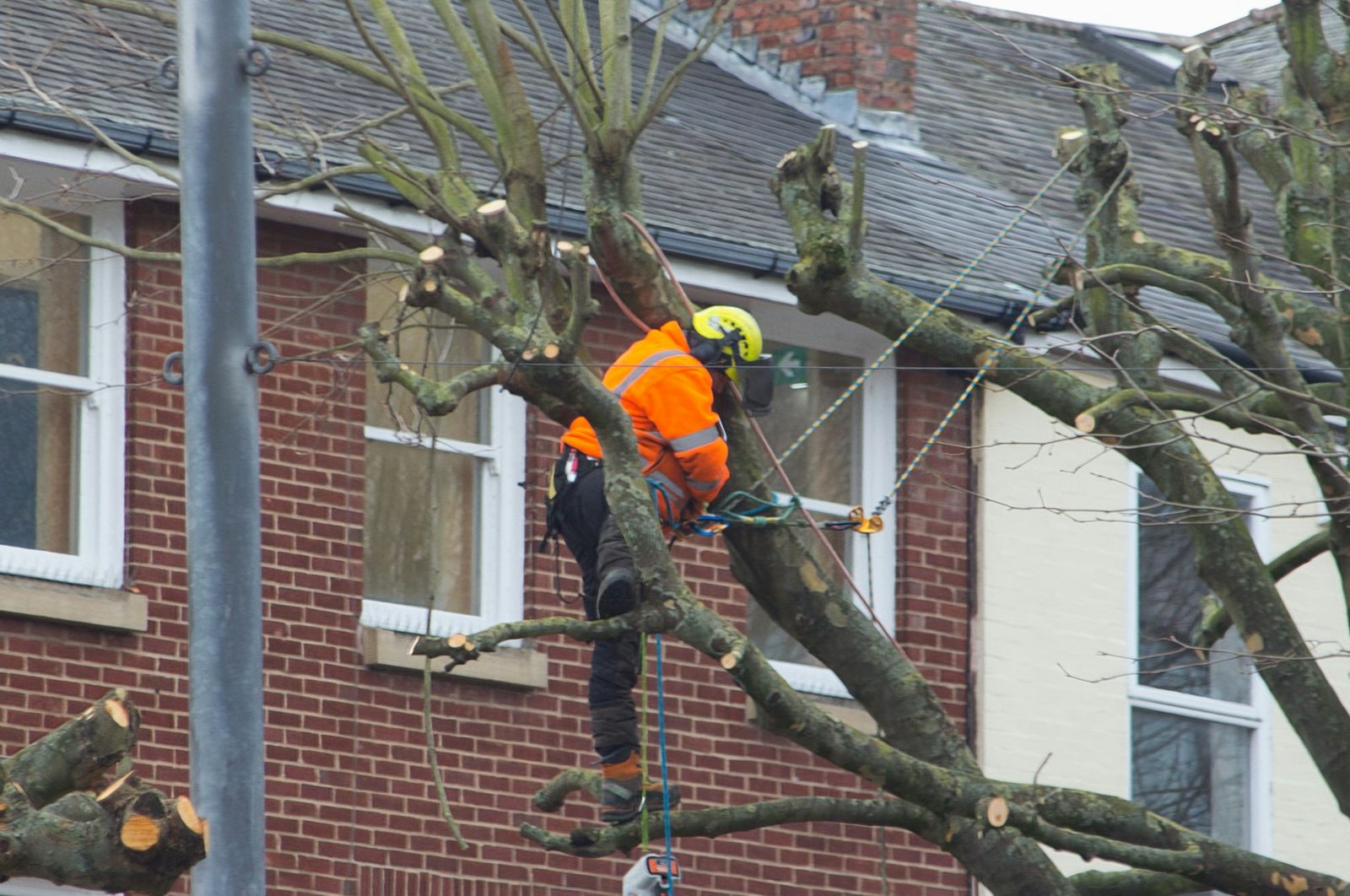
We could not find a City of Oklahoma City page that says who owns, or who may remove, a tree in the strip beside your street, and the online code library the city points to would not open for us. So this page gives what the city does publish, and who to ask. Ask before anyone cuts. We are not the city, and none of this is legal advice.
How wide the strip is
The city's Neighborhood Resources page has this line: "On most streets, the right of way is a 12-foot strip on either side of the street." That line sits in a section about signs, and it says most streets, so measure it as a starting point and not a survey. A tree between the sidewalk and the street is probably in it, and one a little past the sidewalk may be too. Your plat or a survey would show the real line.
The same page says property owners must keep their property, "including alleys and right-of-ways adjacent to their property", clean and free from trash, and its section on high grass says owners are responsible for maintaining those strips. It does not say that makes the tree yours.
Who to ask
| Office | Contact (theirs, not ours) |
|---|---|
| Action Center, for non-emergency reports and neighborhood concerns | (405) 297-2535, action.center@okc.gov, or text (405) 252-1053 |
| Public Works (streets, traffic, drainage) | (405) 297-3451 |
| City Clerk, for trouble reaching the municipal code | cityclerk@okc.gov |
The city's phone list has no entry for trees or forestry, so the Action Center is the place to start. Five questions worth asking, and worth getting answered in an email:
- Is this tree in the right-of-way at my address?
- Who is responsible for it if it is dead or dangerous?
- Do I need a permit or permission to have it removed, and from which office?
- Does a company I hire need anything to work in that strip or block the street?
- Can I replant there, and is there a required species or spacing?
The city's hazardous tree program
The Strong Neighborhoods Initiative runs one program that does take on hazardous trees, under the heading NeighborWoods Hazardous Tree Removal. The page says: "If you need hazardous tree trimming or removal, please check to see if your address is within the eligible area", then join a waiting list by application. It also says "it may take several months". Contact is sniokc@okc.gov or (405) 297-2730. It has English and Spanish forms.
The initiative page lists MLK, Stockyards and Ross Heights/Pitts Park as current neighborhoods, and Classen Ten Penn, Classen's North Highland Parked, Culbertson's East Highland, Capitol View, Capitol Hill and Metro Park as completed. The hazardous tree page does not say whether completed neighborhoods still qualify, so ask. If your tree is about to fall, this is not the route. It is a waiting list.
A separate NeighborWoods program plants trees along streets in those neighborhoods each April.
What the city did after the 2020 ice storm
During that cleanup, city contractors cut and hauled limbs two inches or thicker hanging over public rights-of-way. That shows the city treated limbs over the street as part of that storm's job. It does not tell you who owns the trunk, and it was a one-storm plan.
Utilities and digging in the strip
OG&E says easements and rights of way are often conveyed in a deed, and that it does not need permission to prune for its lines. Digging has its own rule. Oklahoma's dig law exempts a person digging on their own property, not for hire, "except in a private or public easement or right-of way". So that exemption stops at the strip. Use OKIE811 for any digging there, and a company you hire to grind a stump should make that call itself. Its page says to allow at least 3 business days.
If you are planting a replacement
The city's 2016 plant list gives these minimum clearances for street trees. It is a planting guide, tied to code provisions for certain sites, and it does not say every homeowner must follow it. These are still the best local numbers we found.
| Keep the tree away from | Minimum |
|---|---|
| Fire hydrant | 15 feet |
| Street lights | 20 feet |
| Street intersections | 30 feet |
| Overhead lines and power poles | 10 feet, 15 recommended |
| Driveways | 7.5 feet, 10 recommended |
| Underground utility lines | 5 feet |
| Above-ground traffic control box | 3 feet |
| Face of the curb | 2.5 feet back |
The city's tree guide adds that branches over sidewalks should be pruned high enough for walkers and cyclists, and that nothing should block drivers' views in the sight triangle at a corner.
A neighbor's tree
We did not find an Oklahoma statute or state agency page on who may trim a neighbor's limbs, or who pays when a neighbor's tree falls. Some websites state a rule. We could not confirm one, so we do not repeat it. Talk to your insurer about a claim, and a lawyer about a dispute.
If you are not in Oklahoma City
Nichols Hills, The Village, Warr Acres and others are separate jurisdictions with their own rules. Nichols Hills lists Building Inspections and Code Enforcement for permits, and its home page says nothing on trees, so call them.
Still not verified
- The current municipal code text on trees in the right-of-way.
- Whether taking down a tree in that strip, or on a house lot, needs a city permit.
- Any protected or heritage tree rule. Some websites claim them. We did not confirm one.
- Whether a dead tree on private land can bring a code citation. The city's list of common violations covers high weeds and junk and does not name dead trees.
- Owners' association or deed limits.
Phone line opening soon
Allow us to connect you to a local pro.
Sources
- City of Oklahoma City, Neighborhood Resources (code enforcement, right-of-way and signs)
- City of Oklahoma City, Action Center
- City of Oklahoma City, Helpful Phone Numbers
- City of Oklahoma City, Municipal Code page
- City of Oklahoma City, Strong Neighborhoods Initiative, Programs and Contact Information
- City of Oklahoma City, Strong Neighborhoods Initiative (neighborhood list)
- City of Oklahoma City, Storm debris pick-up nearing completion (February 9, 2021)
- OG&E, Frequently Asked Questions on tree work
- OKIE811, The Law (Oklahoma Underground Facilities Damage Prevention Act, law in effect November 1, 2025)
- OKIE811, Homeowners
- City of Oklahoma City, Trees and Plants for Oklahoma City (PDF, dated August 2, 2016)
- City of Oklahoma City Planning Department, Putting Down Roots, second edition, about 2010 (PDF on the state forestry site)
- National Weather Service Norman, Oklahoma City area tornadoes (last updated December 2025)
- City of Nichols Hills, official website
Read on 2026-11-05. External pages can change.